Showing posts with label Theatre. Show all posts

Thursday, November 11, 2010

Kabuki: Japanese Theatre

I couldn’t leave Japan without spending a day at the National Theatre of Japan.  There I watched some Kabuki, a special kind of Japanese theatre known for its colourful costumes, ornate makeup and exaggerated acting. 
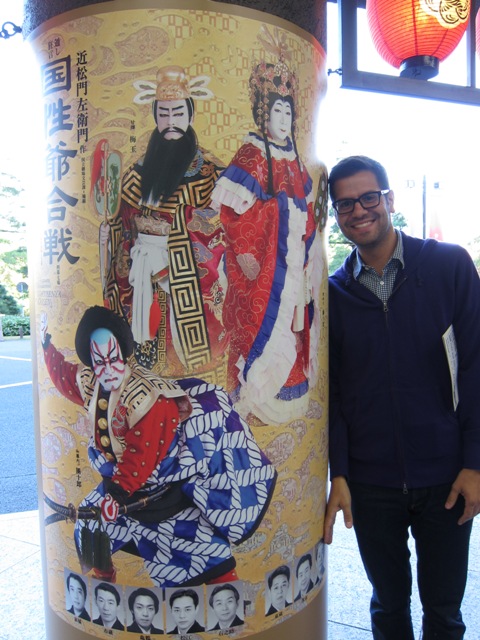
Standing outside of the National Theatre of Japan. I was so excited to watch my first Kabuki performance.
The play I watched was called Kokusenya Kassen (The Battles of Coxinga) and was written by Chikamatsu Monzaemon, the Shakespeare of Japanese theatre.  The play was originally written in 1715 for Bunraku (a puppet performance) but it was later adapted for the Kabuki stage. 
Kabuki is unlike any theatre you will see on a Canadian stage.   The acting is larger than life and the peformers exaggerate every little movement which might seem a bit silly for those not familiar with Kabuki.  The performances are also a lot longer, usually lasting four or five hours.   Another interesting fact about Kabuki is that there are no female actors, all the parts, even the female roles, are played by men.
A statue of a Kabuki actor in the theatre's lobby.  Look at the dramatic makeup and costume. 
Do you think this character is a hero or a villian?
Not anyone can become a Kabuki actor, and usually actors in Kabuki performances come from an acting family (their father and grandfather were Kabuki actors before them).  Take a look at the video below, do you think you would enjoy watching a Kabuki performance?

Tuesday, November 2, 2010

Putting on a Puppet Show

Shadow puppet shows (known as wayang kulit) were once a very popular form of entertainment in Malaysia.  In these shows the puppets were kept behind a screen and the audience only got to see the puppet's shadow,  I guess calling them shadow puppet shows made sense!

A shadow puppet of Hanuman.  Look closely at all the detail that has been carved
out of his clothing.  He must have looked pretty impressive as a shadow.
You have to be very careful when you make a shadow puppet.  If you want the audience to see your puppet's face you can't paint on features like eyes, a nose and a mouth, because the paint can't be seen through the screen.  Puppet makers used leather to make their shadow puppets, and they would carve out all the details using special tools.  If you take a close look at the puppets here you can see how carefully the details are carved out, even things like hair and scales would be carved out so they would be seen by the audience.  The puppet makers would then paint the puppets just to decorate them, but during the show this paint isn't seen and doesn't help the actual performance.  The puppet would also have moving arms and legs that would be attached to its body by special clips.

The puppeteers would use special sticks attached to the arms and legs to move them around.
Have you ever made a shadow puppet?  Get an empty cereal box and try making a shadow puppet of your favourite animal.  Get an adult to help you test it out (you will need a flashlight and a white sheet or t-shirt to do this)  Go back and add the details that are missing once you test it out.  If you get really good at making shadow puppets you should put on a show for your friends and family.  Have fun!

Sunday, September 26, 2010

It Started in Greece.

Did you know that several of things we learn about in school today came from Ancient Greece?  Mathematics, Science and Philosophy were all subjects first studied by the Greeks.  They are also responsible for modern day medicine, as they are known to have performed surgeries to cure illnesses like tonsillitis.  We also have the Greeks to thank for several of our arts like drama and theatre.  They loved the theatre so much that a number of great outdoor stages were built during Ancient times in Greece.  Check out this one.

This theatre was known as Herod Atticus Odeon.  It could seat up to 5000 people!

Odeon means "building for singing competitions", and that is what they were used for.  They are generally much smaller than a full size Greek theatre. 

During theatre productions in Ancient Greece actors would wear masks to help them play their part.  Here are some examples of Greek masks below.

Theatre masks were usually made out of wood or paper, so these masks made out of stone were probably just used as decorations in theatres.

What do you think the play these characters were in was about?  Who do you think was the villain?  Who was the hero?  Why do you think that?
Related Posts with Thumbnails