Showing posts with label Egypt. Show all posts

Saturday, October 9, 2010

Construction Ahead: Sphinx Avenue

Avenue of Sphinxes leading up to Luxor Temple.
Avenue of Sphinxes is a 2.7km stretch of road that once connected Luxor Temple to Karnak Temple.  In ancient times the road was lined with sphinxes and was used in special processions, kind of like a parade, between the two temples.
The Pharaoh would walk along the Avenue of Sphinxes during special ceremonies.
Over time the Avenue of Sphinxes has been lost.  Pieces of it have been built over, and other parts of it damaged.  Today it sits nothing more than a short path of sphinxes in front of Luxor Temple.  The government unhappy with this has decided that it is time to rebuild the avenue and restore it to its original beauty, so they have started a massive project that involves restoring and rebuilding the entire avenue.
Such a pretty sight, the Sphinxes lit up at night.
This is an exciting time for Luxor if you are a fan of Egyptology, but not such an exciting time if you live in the city.  Homes are being torn down to make room for the avenue, and there is construction happening all around, closing streets and slowing traffic.  Some people are very unhappy about the project, but hopefully all the inconvenience will pay off once the Avenue of Sphinxes is completed and the citizens of Luxor can marvel at how beautiful their city is again.

Friday, October 8, 2010

A Visit to Coptic Cairo

When you visit Cairo you will see that it is a predominately Muslim city.  Most of the women are veiled or wear head scarves, and many of the men have carpet burns on their foreheads from praying five times a day on their prayer rugs.  Another reminder that Cairo is mostly Muslim is the call to prayer that booms across the city from minarets scattered about the town.  So is everyone in Cairo a Muslim?  No, not quite.

The Hanging Church in Coptic Cairo, called that because of the way it hangs over the rest of the area.
Tucked away into a corner of Cairo is an area known as Coptic Cairo.  This is the centre, and meeting point for several of the Coptic Christians in Cairo.  Built about 2000 years ago, it is a maze of streets, gardens, churches and homes that is surrounded by a tall wall.

The narrow streets that lead you around Coptic Cairo.  It is a real-life maze!
Many famous bible stories have roots in Coptic Cairo.  Some Christians believe that it is where Moses was found floating in a basket by the Queen who adopted him, and some also believe Coptic Cairo was where Mary, Joseph and baby Jesus came to hide when a king named Herod was killing all the babies in the land.  No one knows if these stories really did take place here, but it if fun to explore the winding alleys of Coptic Cairo anyhow.

Is this really the room where baby Jesus and his parents hid from King Herod?   Depends on who you ask.
Being Friday, the day when Coptic Christians come together from all across Cairo to go to church to celebrate, the buildings are alive and humming with chanting and insense.  The streets are bustling with children running around playing tag as their parents cram into one of the many churches in the area (there are about 8 churches in total!).  It is a beautiful part of Cairo, different from the ancient, and different than the new, it is truly a special place to visit.

A man working hard at restoring St. Barbara church in Coptic Cairo.

Thursday, October 7, 2010

A Kid's Guide to Alexandria

Unfortunately, it is time for me to leave Egypt already.  I have really enjoyed all my time here, but I didn't get a chance to visit Alexandria!  I will have to come back and do that next time I am making my way around the world.

Here are some of your suggestions for my trip to Alexandria one day:

Temple of Hatshepsut

Hatshepsut was an important person in Ancient Egypt, she was one of the only women to rule the kingdom, a job that was usually done by a man.  The story goes that Hatshepsut’s father died, King Tuthmosis I, and since he had no sons to carry on as Pharaoh, Hatshepsut decided to take over and rule the Kingdom, but used her stepson Tutmosis III as a decoy and made it seem like he was ruling. 
Temple of Hatshepsut behind the Valley of the Kings.
By the time she died Hatshepsut had changed the face of the kingdom.  She had peacefully increased trade with several other regions, and of course had added several monuments to the land.  The greatest being her final resting spot the Temple of Hatshepsut. 
Some of statues guarding the temple.
It is an amazing structure that looks like it is almost part of the mountain that it is built in front of.  It was beautifully decorated and had several images of Hatshepsut painted throughout.  Unfortunately once she died Tutmosis III, her stepson, really did take power and he was so angry that she prevented him from ruling for years that he decided to destroy all the images of Hatshepsut in the Kingdom.  Luckily statues were considered sacred and god-like so Tutmosis III didn’t dare destroy those.  You can still see some of the statues of Hatshepsut in the temple, and even visit her obelisk that stands in Karnak Temple which is considered to be another sacred monument.
 
The obelisk that Hatshepsut added to Karnak Temple when she was ruler of the Kingdom.  Her stepson couldn't destroy it once he became true ruler because it was considered sacred, so he built a wall around it instead so that no one could see it.

Wednesday, October 6, 2010

An Egyptian Kid’s Breakfast

I believe that the best way to get a feel for how the local people of a city live is to visit one of their supermarkets.  It is fun exploring all the different foods that are available to buy, and to look at the neat packaging and how it is the same or different from the packaging where you live. 
While in an Egyptian supermarket I came across the cereal aisle and I was amazed by what I saw.  Take a look at the picture below and think about how this cereal aisle is the same, or different, than the one in your local supermarket.  Why do you think I was surprised by what I saw?
Do you see your favourite cereal here?

Valley of the Kings

The Step Pyramid of Saqqara, the oldest pyramid in Egypt.
All the pyramids of Egypt date back to the Old Kingdom, the first kingdom in ancient times.  They were built as a final resting spot for the Pharaoh and the treasures that he was buried with.  Unfortunately the pyramids were also huge signs to robbers, they  screamed, “come to me, I am filled with treasure.”   Unfortunately, all the pyramids were being robbed of their treasures, so the pharaohs decided to start building secret tombs hidden away in the desert, tombs that no robber would be able to find.  These tombs are known to us today as the Valley of the Kings.
The Valley of the Kings was chosen as a burial site for several reasons.  First is the natural pyramid like rock formation that sits on top of the hills around the valley.  With a pyramid being a sacred shape, the pharaohs couldn’t ignore this as a sign.  The next reason is that the Valley is on the west side of the Nile where the sun “dies” at the end of each day as the sun always sets to the west.  So the pharaohs lived on the east side of the Nile (where the sun was born), but would be buried on the west side (where the sun died).
The rocks and hills that surround the Valley of the Kings.
Even though a lot of work was put into hiding the tombs and their treasures, all of them were eventually found by tomb robbers, except of the smallest tomb which belonged to Tutankhamun (but you probably know him as King Tut).  His treasures were found in 1922 by a British archaeologist named Howard Carter.  The treasure he found in the tomb is now on display at the Egyptian Museum in Cairo.
The Valley of the Kings across the Nile.
All the tombs are different shapes and sizes, and the bigger the tomb, the longer you ruled as Pharaoh.  The tombs were started when you became Pharaoh and only stopped being built once you died.  That is why the tomb of Ramses II is the largest, he ruled for around 60 years, and the tomb of King Tut is the smallest, because he was only in power for about 10 years. 
Image from inside a tomb taken from the Internet.
Unfortunately no pictures are allowed in the tombs because the camera’s flash can damage the beautifully painted walls, but you can just imagine it (or do a Google search for Valley of the Kings and you will find several images).  Dug deep into the hills of the desert, massive chambers and passageways leading to the tomb were a pharaoh would be laid to rest for eternity. All of this built with no jack hammers, no drills, just some simple tools and their hands.  Amazing!

Tuesday, October 5, 2010

Hannah Montana Around the World.

So what do boys and girls in Egypt watch on television (if they have one, many families don't have a television in their homes)?  Well Hannah Montana of course!  To make sure that the boys and girls can understand what is being said in the program Arabic subtitles come up across the bottom of the screen.  The children read the writing on the screen from right to left, unlike you who reads from left to right.  It is interesting to see that the shows you watch are also being watched by children around the world.

Hannah Montana on the Disney Channel in Egypt.

Temple of Karnak

Standing in front of Karnak Temple, the largest temple in the whole world.
The largest temple in all of Egypt, actually, it is the largest temple in the whole world,  Karnak is unlike anything I have ever seen.  The Temple of Karnak started being built in the Middle Kingdom (Ancient Egypt had three main periods:  the Old Kingdom, the Middle Kingdom and the New Kingdom, all in that order) and it was still being added to 1300 years later.
A statue of Ramses II in the Great Hall.
Temples were not used as residences, all Egyptians, even the Pharaoh, lived in houses made out of mud brick.  They believed that since life was temporary, their homes should be temporary too.   Temples were made out of stone and marble because they were meant to last forever, just like they believed the afterlife would.  Temples in Egypt were dedicated to gods and used as a spiritual centre.  Karnak is dedicated to the god Amun and it was used daily in special celebrations by the Pharaoh and his priests.
The ram-headed sphinxes all in a row.
The temple is divided into several different areas.  Before entering the temple you must walk down a processional path lined with ram-headed sphinxes then pass through a gate in the first wall.  The wall towers over you and is 45m high.  Once inside the temple you will walk through a Great Court and then enter into the Great Hypostyle Hall.  This hall contains over 100 pillars, each one decorated beautifully with images of gods, pharaohs and hieroglyphics.  Originally the entire temple would have been brightly painted a rainbow of colours.  With the temple being this detailed no wonder it took over 1000 years to finish.
Look at the carvings on each of the pillars.  Each one is completely covered from top to bottom.

My Egyptian Ferrari

Life in Luxor is much more relaxed then life in Cairo.  Tourism is the main industry in Luxor, so most of the locals make a living by either selling you something or offering you a service.  I would like to introduce you to one of these locals, Ali. 
An Egyptian Ferrari powered by the beautiful Cinderella.
While waiting for the bus Ali approached me and offered me a ride in his “Egyptian Ferrari”.  I politely declined but began talking to Ali about life in Luxor.  He told me about his family, he is married and has two young kids with another on the way.  Unfortunately Ali didn’t get a chance to go to school, he was too busy working trying to make money to support his family when he was younger.  As a boy he would mix in with the tourists talking to them and using his charm to sell assorted souvenirs and “Ferrari rides”, this is how he learned English and four other languages, by spending every day with different tourists. 
Cinderella leading the way to my hotel along the Luxor streets at night.
Ali and his story won me over and I let him take me for a spin on his Ferrari.  He wanted to take me on a grand tour of Luxor, but I felt bad for Cinderella, his horse, who was slowing down because she was hungry, so I asked Ali to take me to my hotel and he did.  So twenty minutes later we arrived at my stop and I said goodbye to Ali and give him some money for the journey.  Then from the carriage I used my favourite form of transportation, my feet, to get me up to my bed for the night.
My driver Ali waiting for his next rider in the dusty Luxor night.

Cities of the Nile

Egypt has a desert climate.  The land is sandy, and no vegetation grows in the desert.  It is hot and dry the whole year, except for the few rain showers that fall in the winter.  The two cities that I have explored so far, Cairo and Luxor, are both cities that were built on the banks of the Nile River.   When you look at a map of Egypt you can see that all main Egyptian cities can be found along the Nile.  It is the water of the river that provides life to the plants, animals and people of Egypt.  Without fresh, clean water, there can be no life. 
Cairo along the Nile.  Look at the rows of buildings.
The river is important in another way too.  In ancient times people would use the Nile as a highway and travel around Egypt on their boats.  Without the Nile it would be hard to get around Egypt quickly.  You would have to ride a camel, or use a horse, but in the scorching sun that could be unbearable.  You can still see people drifting along the Nile on their boats today.
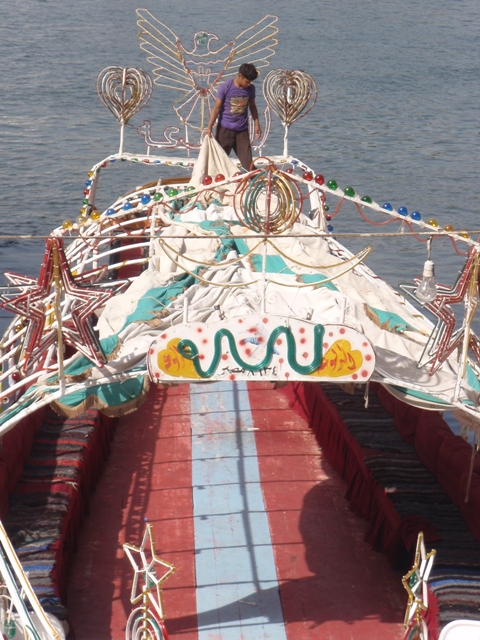
 A boat sailing along as the sun sets over the Nile in the city of Luxor. 
Think back to all the places I have visited so far and look at them on a map.  Are any of these other places near water? (Remember: Reykjavik, London, Istanbul, Athens)

Egyptian Street Food

An Egyptian McDonalds.  Doesn't it look fancy?
Walking around the cities of Egypt under the blazing sun can really help you work up an appetite.  Egyptians are fans of Western fast food and you will find teenagers lined up to buy a Big Mac or a combo at Kentucky Fried Chicken.  If you rather a slice, you can always grab a table at Pizza Hut.  Although these restaurants are popular with the young crowd, many of the older Egyptians still prefer to eat more traditional meals. 
Kushari, a delicious cheap and cheeful Egyptian lunch.
As I was walking along one day I came across a little restaurant that was full of Egyptian men eating bowls of kushari.  Kushari is a traditional dish that is made by mixing pasta, rice, lentils, and fried onions, then covering it all with a spicy tomato sauce.  It may not sound or look that appetizing, but I can promise you that it is delicious.  The best part is that a big bowl of kushari, with a water or pop, costs you only 5 Egyptian pounds, which is equal to 1 Canadian dollar.  Now that is a bargain.

Monday, October 4, 2010

I Am Here - Luxor, Egypt


View Larger Map

The Riddle of the Sphinx

The Great Sphinx of Giza
In front of the Great Pyramids of Giza sits the largest statue of a Sphinx, (part human, part beast) in the world.  It is 76.5m long and about 20m tall.  Not only is it big, but it is also really old.  The Sphinx is one of the oldest monuments on Earth being around 4500 years old.  Now because it is so old we don't know much about it.  There are still questions of who built it, what purpose it served, who it was modelled after and why parts of it are missing (like its nose and beard!)?  So over the years many theories, and even some legends, developed to help people answer questions about the Sphinx.

The Sphinx on guard, keeping evil away from the Pharaoh.
Some believe the Sphinx was built in front of the pyramids to act as a guard, protecting the Pharaoh in the afterlife.  Others believe that he was an image of the sun god and that Egyptians would come and pray to the statue for good luck.

There are some interesting tales about the missing nose too.  Some Egyptologists believe that the nose was cut off by an invading ruler who didn't like the way people were worshipping the statue.  Another story about the nose is that when the French were occupying Egypt it was shot off during target practice by Napoleon's soldiers.

Whatever the true story is one thing is certain, the Sphinx was built to inspire awe, and it can still do that today even after 4000 years.

A different Sphinx in the Ancient City of Memphis.  This one is much smaller than the great Sphinx, but it still has its beard and nose intact.

Saturday, October 2, 2010

Mr. P Sees the Pyramids!

Dear Boys and Girls,

Today will be a day that Mr. P remembers for the rest of his life.  I remember hearing about the pyramids when I was a child, they were a symbol of ancient civilizations that came before us.  A group of people that started to change the way we as humans see the world and helped the world get to where it is today.  So to be standing, facing the pyramids was very special to me.  I couldn't help but grin.  Also making the day extra special was my very kind and knowledgeable tour guide, and now friend, Feby.  If ever you are in Egypt and want to arrange a tour of the pyramids, make sure you e-mail her (click on her name above and tell her Mr. P sent you).  She was an amazing host and was excited to give me several stories to share with you.  Wait until you hear the one about the Egyptian vampire!


There are many pyramids in Egypt.  Pyramids were used as a final resting place for Pharaohs and their families.  They were built well in advance of them dying because they usually took around 20 years (if not longer) to build.  The pyramids were stuffed full of treasures, usually things that the Pharaoh was believed to have needed in the afterlife.  The three pyramids at Giza (shown in the picture below) belong to a grandfather, father and son team.  The largest pyramid is known as the Great Pyramid of Cheops.  It is made up of about 2.5 million blocks and rises 137m out of the desert sand and is the most impressive of the three.  You can just imagine how it must have looked 4000 years ago when it was first completed.  Back then it was covered in polished limestone which would have made it shine in the sun, a sparkling pyramid fit for a king.

Standing in the desert.  Oh look...the Great Pyramids of Giza are behind me.  Now how did those get there?
The Egyptians used pyramids as tombs for several reasons; first their shape reminded them of sun rays coming down from the sky.  Also, a pyramid reaches high up into the sky ending in a point that shoots directly up.  Sometimes it looks like the pyramid is actually touching the sun.  The pyramids were believed to give the souls of the dead Pharaohs a way of getting up into the heavens where they would have eternal life.

Great Pyramid of Cheops touching the sun.
There is so much more I could tell you about the pyramids...they are truly amazing, but I will let you sign a book out from the library or do a Google search so you can learn some more on your own.  I can't wait to hear about some of the interesting facts that you learn!

Still grinning,
Mr. Pimentel

Friday, October 1, 2010

The Markets of Cairo

A street lined with clothing stores for both adults and children.

Shopping in Cairo can be just like shopping at home.  There are fancy stores lining big boulevards selling Egypt's  latest fashions.  There are even shopping malls where you can hide from the heat as you browse through all the sheltered shops.
 
What the kids are wearing, notice how they are all wearing pants.  Even though it is very hot in Cairo, you won't find many pairs of shorts for sale.  Most Egyptians are Muslim, and they favour a more conservative way of dressing, and shorts are considered too casual.
But to shop in true Cairo style is to shop in the markets of the city.  There are several markets scattered all around the city.  There is a market for clothing, a market for fabric, a market for fruit and vegetables, even a market for car parts...you can find a maket selling just about anything if you search long enough.  The joy of shopping in a market is that you are outside enjoying the sunshine and the sounds of the streets, which unfortunately is just the sound of horns honking most of the time, but at the right time you might be outside as the call to prayer is being broadcast from a local mosque.

A busy fruit market in some of the back streets.

The crazy car part market where you can find just about any part for any car.

The clothing market just getting started.  All the umbrellas are setup to help give the vendors and shoppers some shade from the blazing sun.
Another fun thing about the street markets are the people you meet.  People are always happy to see you and they ask you where you are from, and sometimes offer you a cup of tea in hopes that you might give them a little baksheesh (a little gift of money).

Have you ever been to an outdoor market?  What kind of things did they sell there?

Getting Around Cairo

Getting around Cairo is not easy.  The city is very crowded, so driving a car can be scary and frustrating.  Walking is also difficult because the desert climate is hot, and shade can be hard to come by in some areas.  Taxis are available, but they also get stuck in traffic.  So how do the people of Cairo get around?  There are a couple of ways.

The first, most dangerous way, is by bus.  You will see men and women standing by the side of the road waiting for a bus, and as it passes it slows down (sometimes not stopping) and those waiting will leap on trying to make sure they get on the bus before it speeds up again.  The bad things about buses is that they get really crowded in the middle of the day, and again if traffic is bad, you aren't going anywhere fast!

A bus, and a mini-bus behind it with a man hanging out ready to jump off.
A safer way to travel is on the new Metro system.  The Egyptian government has realized that Cairo is getting too crowded, and that building more roads for cars will just make the problem worse, adding more pollution into the air.  Thankfully, they have come up with a great solution and have built a subway system.  There are currently two lines that run in an x across Cairo and there is a third line being built (they hope it will be done by 2019) that will connect the airport to the city.  Costing only 20 cents, it is a quick and cheap way of getting around parts of Cairo.

The new and efficient Metro pulling out of the station.
What are some other green ways the people of Cairo can use to get around their city?  I am giving you a hint below.  Can you think of any others?

A boy getting his felucca ready for the day.

Thursday, September 30, 2010

Cairo Tower

When it was built in 1961 the lotus inspired 187m tall Cairo Tower was the tallest concrete structure in the world.
Towers are a great place to take in how big a city truly is, and let me tell you, Cairo is a huge city.  It has a population of around 17 million people making it a very densely populated area (dense is when there are a lot of people in a small area).

Taking in the view from the observation deck.
Looking down at Cairo from Cairo Tower you can see the density.  The buildings look like they are all attached.  They appear to all sit ontop of each other as they move away from the Nile River and into the desert. 

Cairo is a very hot city, today it was around 40 degree Celsius.  You can almost see the heat in the picture below, it is like a haze that sits above city (that haze is also smog coming from all the busy roads all around Cairo).

The haze sitting over Cairo.  Doesn't it look like all the buildings are connected?
Not only did I get an amazing view at Cairo Tower but I also made a friend.  My friend's name is Ahmed.  Ahmed works at the tower as a photographer.  When you arrive he offers to take a picture of you standing in front of the tower, and if you like the way it looks you can buy it as a souvenir.  When he asked if I would like my picture taken, I said "No thank you, I don't have any money to buy it with."  Ahmed asked me where I was from and why I was in Cairo.  I told him that I was a teacher from Toronto who was travelling the world to learn more so that I could teach more.  My story made Ahmed smile, so he asked if he could take a picture for me on my camera so I could have one of "Mr. P standing in front of Cairo Tower" to show you.  The picture was taken, but because it is so bright and sunny outside we didn't notice that my eyes were closed in the picture!  All that kindness that Ahmed showed me and I end up with a picture of me sleeping in front of the tower.  It is a memory of his kindness that I will always keep no matter how funny I look in the picture.


Mr. P sleeping in front of Cairo Tower.

Do you have a picture of yourself that you like because it tells a funny or happy story?  Bring the picture in and share it with you class.

Kid's Guide to Cairo

Your guide has gotten me really excited about Cairo.  Thanks for the warning about the desert climate.  I put on a thick layer of sunscreen before getting off the plane and I am sure glad I did because it is almost 40 degrees Celsius. That sun sure is hot.  I like how you have me wearing a hat in the picture too.  I think I hat in this kind of weather is a great idea.


I Am Here - Cairo, Egypt


View Larger Map
Related Posts with Thumbnails