Thursday, November 11, 2010

No Ordinary Garden

In the middle of Tokyo, the gardens around the Imperial Palace are a great place to find some peace and quiet.
Just take a walk through a traditional Japanese garden and you will quickly realize why these are no ordinary gardens.  With beautifully landscaped grounds, ponds of brightly coloured koi and statues scattered all around, there is a peaceful charm to a Japanese garden.

Koi are famous for being the longest living veterbrates, they can live to be over 200 years old.
The garden around the Imperial Palace in Tokyo is a great place to start your exploration of a proper Japanese garden.  With all the elements you would expect to find, this garden is a great place to read, picnic or simply stroll.

By a trickling waterfall, this stone lantern sits ready to light the night.
Think of your community.  Is there a garden that you like to visit?

Kabuki: Japanese Theatre

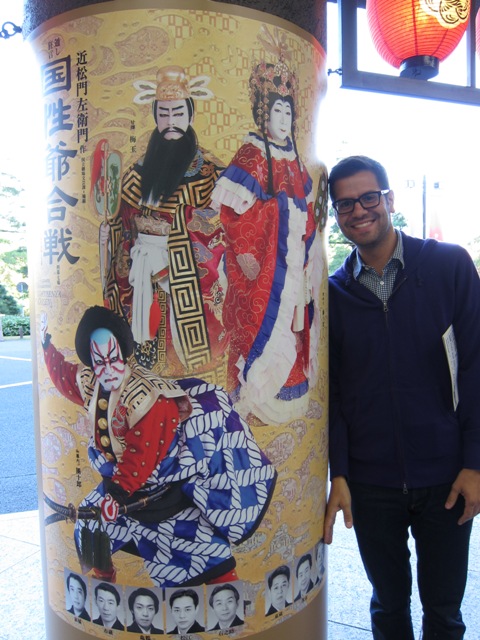
I couldn’t leave Japan without spending a day at the National Theatre of Japan.  There I watched some Kabuki, a special kind of Japanese theatre known for its colourful costumes, ornate makeup and exaggerated acting. 
Standing outside of the National Theatre of Japan. I was so excited to watch my first Kabuki performance.
The play I watched was called Kokusenya Kassen (The Battles of Coxinga) and was written by Chikamatsu Monzaemon, the Shakespeare of Japanese theatre.  The play was originally written in 1715 for Bunraku (a puppet performance) but it was later adapted for the Kabuki stage. 
Kabuki is unlike any theatre you will see on a Canadian stage.   The acting is larger than life and the peformers exaggerate every little movement which might seem a bit silly for those not familiar with Kabuki.  The performances are also a lot longer, usually lasting four or five hours.   Another interesting fact about Kabuki is that there are no female actors, all the parts, even the female roles, are played by men.
A statue of a Kabuki actor in the theatre's lobby.  Look at the dramatic makeup and costume. 
Do you think this character is a hero or a villian?
Not anyone can become a Kabuki actor, and usually actors in Kabuki performances come from an acting family (their father and grandfather were Kabuki actors before them).  Take a look at the video below, do you think you would enjoy watching a Kabuki performance?

Tuesday, November 9, 2010

People, people and more people!

Once you look up the population of Tokyo it should come as no surprise that it is a busy place.  With around 13 million people living in Tokyo (there are only 2.5 million living in Toronto) it is no wonder the city streets, trains and buildings are crowded places.

This crosswalk in Shibuya is the busiest crosswalk in the world!
So how does a city with so many people work so smoothly.  Rules!  There are labels on the ground showing you what side of the pavement to walk on, crosswalk signs that everyone follows, lines that people never try to cut in front of, rules that all citizens follow.  This keeps things running smoothly without jams, pushing or shoving.  Things always stay organized because everyone always stays calm and most importantly they don't rush.

A sea of people floats along this shopping street in the neighbourhood of Harajuku.
Think of your school, what are some rules that keep things running smoothly? (Do you only walk up one side of the stairs?  Do you wait patiently at the water fountain?)

The most important rule to remember when among a large crowd of people.

All About Sushi

Sushi has become a popular dish all around the world and you can find sushi restaurants in Europe and North America, but there is something special about having a sushi dinner in Japan, the country where sushi was invented.

Originally a dish that involved fermenting fish in vinegar (making the fish sour) before eating it, sushi as we know it today was only invented in the early 1800's as a form of fast food.  Japanese people wanted a food that could be eaten quickly on the street or in a theatre, and that is when raw fish started being used instead of fermented fish.

A chef in Tokyo hard at work preparing a sushi set.
Sushi can come in many different variations.  Nigirizushi is when the raw fish lies across a ball of rice, makizushi is when a cylinder wrapped in nori (a sea algae) is cut into small discs of sushi yumminess and another popular kind of sushi is sashimi, when the raw fish is served as is with no rice.

Done all my sushi, I am using my chopsticks to dig for more meat
in these lobster heads from my lobster miso soup.
Unlike sashimi, most sushi is meant to be eaten with your hands.  Made to be bite sized by the sushi chef, you carefully pick up the nigirizushi, lightly dunk it in soy sauce fish side down, and then pop the whole thing into your mouth.  Chopsticks can be used to eat the pickled ginger provided to clear your palate and help you digest the meal, but trust me you are allowed to use your fingers to eat the rest of it.  Now when do you ever hear that?

Monday, November 8, 2010

Shichi-Go-San (Seven-Five-Three)

A busy Sunday at the Meiji Shrine in Tokyo.

Paper lanterns decorate the gates that lead you into the shrine.
Visiting the Meiji Shrine in Tokyo was a great day out.  Not only did I get to see the Shinto shrine up close, but I also got a chance to be part of a very special Japanese celebration known as Shichi-Go-San (or Seven-Five-Three).  This is when girls who are three and seven, and boys who are five (Japanese people believe odd numbers are good luck) visit a shrine on (or around) November 15, to cast away evil spirits and wish for a long, happy and healthy life.

Great care is taken with every little detail.  From head to toe the children
look perfect for their special day.
This is a special day and the children wear a traditional outfit called a kimono.  For some children it is the first time they have ever worn one of these.  They are followed around by family members who snap pictures of them posing in front of the shrine.

Posing with her mom and brother this little girl will always remember this special day.
The children also receive special treats on this day like chitose ame, a red and white long candy stick that is known as "thousand year candy".  Balloons can be seen floating around, a big teddy bear mascot is on hand to be hugged and there is even a play that is performed in the park for families to enjoy.
 

A five year old boy all dressed up for his big day.

Is there a time when you have worn special clothing or a traditional outfit?  Do you have any pictures of that special day?

Sunday, November 7, 2010

Plastic Food: Not Just For Playing House

Eating in Tokyo has been an adventure.  With most menus being in Japanese, ordering can be challenging and usually involves playing a game of Charades with a very helpful waiter (who I am sure wishes I had just learned some more Japanese before I arrived in Tokyo).  Having a mini-dictionary with you is also helpful, but sometimes the writing is so small it is hard for the waiters to see the tiny Japanese characters in the dim restaurant light.  That is when a Japanese trend comes in handy.  What trend am I talking about?  Plastic food.
Plastic food on display outside of a Thai restaurant in Tokyo.
It is pretty common to see huge display cases outside of restaurants with full meals made of plastic on display.  These models are meant to entice customers and get them interested in the food the restaurant is serving.  The only problem is that the plastic food usually looks disgusting, and is nothing like the real food that is available inside. 
Sometimes the plastic food leaves you quite confused about what items are available inside the restaurant.
Sometimes the fake food does look real, and there can be a great amount of detail put into the plastic items.  There will be times when the plastic food looks so good, it definitely makes you want to check out what the real meal looks like.
Even desserts will be on display in plastic.  I think they look the most real and delicious!
Do you think restaurants in your city should start using plastic food to advertise their meals to customers?

Saturday, November 6, 2010

A Kid's Guide to Tokyo

Your guide is really going to come in handy!  Most of the signs in Tokyo are in Japanese (restaurant menus too) so it is tough knowing exactly where you are, and in some cases, what you are eating!  I can't wait to explore some of the places on your list.


Related Posts with Thumbnails